
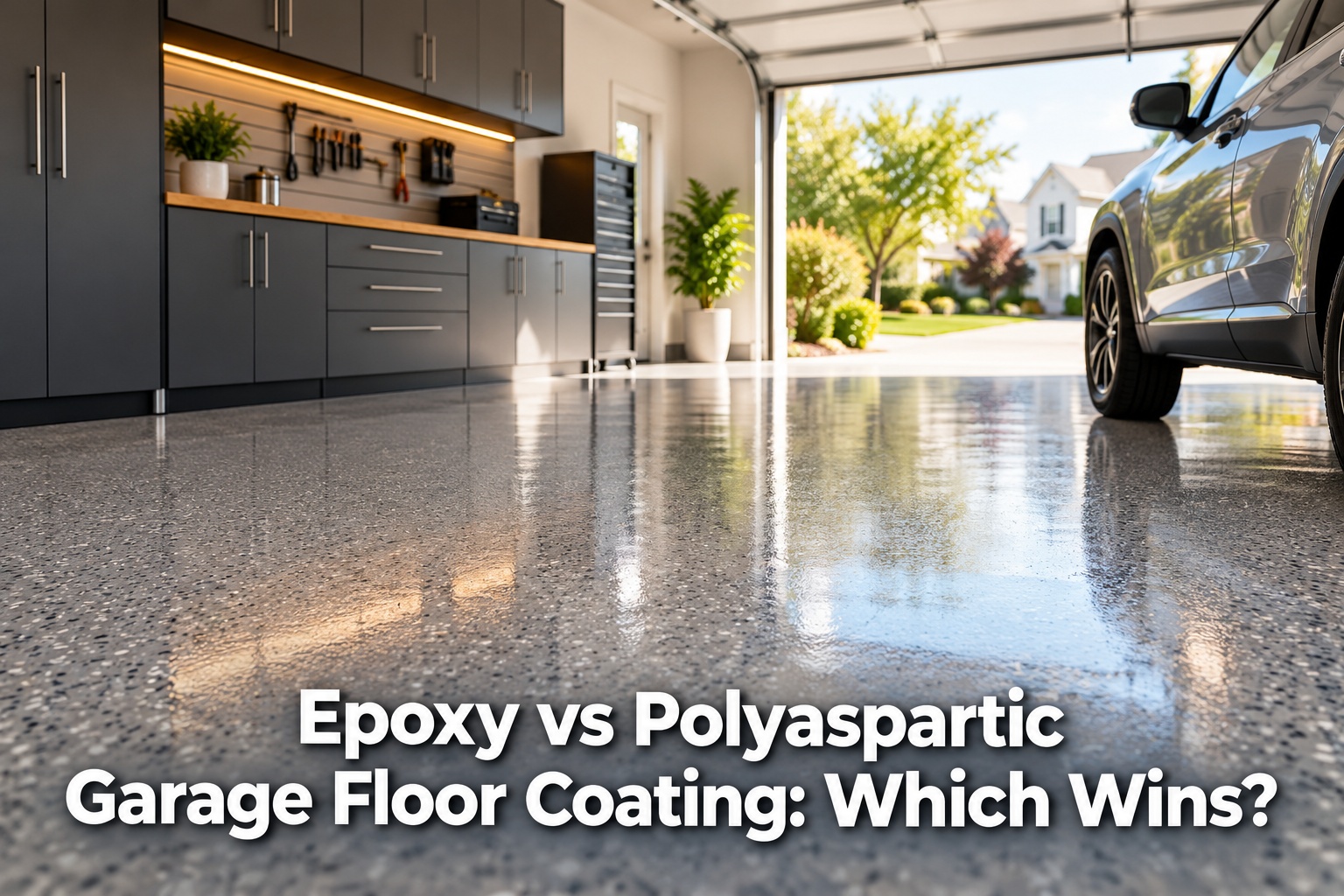
Two coatings, both sold as pro-grade, and a garage floor that has to survive hot tires, road salt, dropped tools and a South Jersey summer. Every homeowner who starts shopping hits the same wall: one installer swears by epoxy, the next swears by polyaspartic.
Here is the honest answer up front. Neither coating wins on every point. The right pick depends on working time, sun exposure, slab condition, temperature and the complete system, not just the name on the bucket.
This guide covers the chemistry, property-by-property performance, thickness, the polyurea confusion, hybrid systems and cost drivers. We install epoxy garage and basement floors, so this comparison comes from the contractor’s side of the job.
| Factor | Epoxy | Polyaspartic |
|---|---|---|
| Working time | Longer | Shorter |
| Cure speed | Slower | Rapid |
| Sunlight stability | Depends on topcoat | Marketed as color-stable |
| Best known for | Build and decorative work | Fast turnaround and UV stability |
What Is the Real Difference Between Epoxy and Polyaspartic?
The main difference is chemistry, and chemistry shapes how each coating behaves on installation day. Everything else, from cure speed to scheduling, follows from that.
How Epoxy Works (Resin, Hardener and Working Time)
Epoxy forms when resin and hardener are mixed, which starts a chemical reaction. From that moment the clock runs, and the installer must apply and finish the material within the product’s working time.
Epoxy systems offer resistance to impact, chemical spills and mechanical wear. The longer working time is a real advantage on careful, even application and on decorative work, where a crew needs minutes to place flake and level the surface.
How Polyaspartic Works (Rapid Cure Chemistry)
Polyaspartic coatings are designed to cure rapidly. One manufacturer system states cure in as little as 2 hours per coat, but that figure is specific to the product and system. Temperature, humidity, coating thickness and site conditions all affect scheduling.
Faster cure also means a shorter window to work, which is why crew experience matters. Return to service follows the specific manufacturer’s requirements, so nobody should promise you can park the same afternoon.
Epoxy vs Polyaspartic by Property
A single winner hides the details, so compare the two property by property.
Adhesion to Concrete and Surface Prep
Both coatings depend on the selected system and on substrate preparation. Cleaning, profiling the concrete and repairing cracks and spalls matter more than the coating name.
Can polyaspartic go directly on concrete? It can be part of a properly prepared system, but the right system and prep are specified slab by slab, never assumed.
Impact, Abrasion and Chemical Resistance
Epoxy systems offer resistance to impact, chemical spills and mechanical wear. Polyaspartic systems are described as resistant to chemicals and abrasion and suited to demanding, high-traffic environments.
Both perform well in a garage when installed properly. Neither is guaranteed against every chemical, impact or hot-tire condition, and results depend on product selection, preparation, installation and use.
UV Stability and Yellowing
Polyaspartic coatings are marketed as UV-resistant and color-stable, while some traditional coatings can yellow after sunlight exposure. That does not mean epoxy always yellows or polyaspartic never changes.
Outcomes depend on the formulation, the UV exposure and whether a UV-stable topcoat is used. Sunlit slabs and garages with big south-facing doors deserve extra thought here.
Moisture, Slab Condition and Slip Resistance
Manufacturers offer separate products and systems to address concrete moisture and vapor transmission. The coating alone is not the fix, and we never call either one waterproof in a way that implies it stops structural leaks. The slab or walls can still admit moisture.
A slab with water intrusion or hydrostatic pressure needs evaluation and a proper moisture-mitigation system first.
On traction, smooth resinous floors can be slippery when wet. Finishes can be smooth or textured, and texture can be added for grip.
Coating Thickness and System Build
A garage floor is a system, not a coat of paint. A typical build includes prep, a primer or base coat, optional broadcast, and a topcoat.
Thickness is measured in mils, and each layer has a job. The base coat provides build and adhesion, while topcoats handle wear, UV and chemical resistance.
Manufacturers organize their systems by thickness, from thin coatings up to multi-millimeter builds, and thicker multi-layer systems suit heavier use. The right build is specified per slab and per use, which is why we look at your floor before recommending anything.
Is Polyurea the Same as Polyaspartic?
No. They are related but distinct chemistries. Polyaspartic is a type of aliphatic polyurea with a slower, more workable cure.
In plain terms, polyurea is typically faster and less forgiving to apply, polyaspartic offers rapid cure with a bit more working time, and epoxy offers the longest working time of the three.
The right choice still depends on the slab, the conditions and the system around the coating.
Pros and Cons of Each Coating
Epoxy Strengths and Limitations
Epoxy’s strengths are working time, resistance to impact, chemical spills and wear, and a long track record in decorative work. The extra minutes help crews get an even, flawless finish.
Limitations are real too:
- Slower cure means a longer wait before return to service.
- Some formulations can yellow in sunlight without a UV-stable topcoat.
- Temperature and humidity affect application and scheduling.
Polyaspartic Strengths and Limitations
Polyaspartic’s strengths are rapid cure, UV resistance and color stability, plus resistance to chemicals and abrasion. Fewer waiting days can mean less disruption to your household.
Limitations to weigh:
- A shorter working window leaves less room for error.
- Results depend heavily on crew experience and conditions.
- It is not automatically superior to epoxy, and slab moisture still needs its own solution.
Hybrid Systems and Decorative Flake Finishes
Many of the best garage floors use both chemistries, each where it performs best.
Epoxy Base With a Polyaspartic Topcoat
A common hybrid pairs an epoxy base for build and adhesion with a polyaspartic topcoat for UV stability and wear. Polyaspartic can be applied over epoxy when the existing surface is in good condition and correctly prepared for intercoat adhesion.
Flake and Quartz Options
Decorative flake and quartz broadcast systems add color, texture and a natural grip. They also hide minor slab imperfections and dirt between cleanings.
Because texture adds traction, these finishes suit garages where wet tires and snowy boots are routine.
What Drives the Cost of Each Option
Cost comes down to the slab and the system, not just the coating chemistry. Prep is the biggest swing factor, since cracks, spalls, old coatings and moisture concerns all add labor.
From there, the number of layers, the thickness of the build, the finish (solid color, flake or quartz) and the square footage move the price up or down. Entry level systems are thinner, mid range systems add flake, and premium systems add layers and decorative broadcast.
Polyaspartic and hybrid systems usually sit higher than a basic epoxy build.
Final Verdict
Epoxy wins on working time and decorative flexibility. Polyaspartic wins on cure speed and sunlight stability. Hybrids often capture the best of both.
The coating matters, but preparation and installation matter more. A well-prepped slab and an experienced crew will outperform the fanciest product applied poorly.
Our crew looks at your slab, your sun exposure and your schedule before recommending a system.
Ready to see what fresh paint does for your home? Call LVS Custom Paints at (609) 778-7451 or request a free estimate.
Frequently Asked Questions
Is epoxy or polyaspartic better for a garage floor?
Neither wins every time. Epoxy offers longer working time, while polyaspartic cures faster and resists sunlight. The slab, schedule and complete system decide the best fit.
How soon can I park on a polyaspartic floor?
Cure speed varies by product, temperature and thickness. Follow the manufacturer’s return-to-service requirements, and we will give you a clear timeline for your system.
Will epoxy or polyaspartic turn yellow in the sun?
Some traditional coatings can yellow, while polyaspartic is marketed as color-stable. Results depend on the formulation, exposure and whether a UV-stable topcoat is used.
Can polyaspartic go over existing epoxy?
Yes, when the epoxy is in good condition and properly prepared for intercoat adhesion. We evaluate the floor first.