
Peeling at the trim, chalk on your hand when you brush the siding, and a green film creeping up the north wall. If your house sits near the bay or the ocean, these problems tend to show up sooner than the paint can promised. The best exterior paint for salt air is part of the answer, but only part.
The real answer is a combination: the right coating, honest prep, and a careful professional application. A great product over a salty, chalky, damp surface will still fail early.
LVS Custom Paints is a South Jersey exterior painting contractor, and our crew does the work ourselves on shore homes in Atlantic County and the surrounding area. We want to set honest expectations up front. No paint is salt-proof, and this guide explains what actually improves how a coating performs near the water.
What Salt Air, Wind and Humidity Do to a Jersey Shore Exterior
A house at the shore faces three stressors at once: salt, wind-driven rain and humidity. Each one is manageable on its own. Together they test every weak point in a paint job.
Coastal exposure tends to show up in familiar ways. Colors fade and surfaces chalk. Mildew spreads on shaded walls. Metal railings and fasteners rust and stain the siding below them.
Benjamin Moore guidance notes that temperature, humidity and other factors affect the rate of chemical reactions in coatings. That matters here because shore weather swings often, and a coating that cures in cool, damp air behaves differently than one applied in a dry spell. The same guidance points painters to the finish-coat technical data sheet for primer requirements, which is why we read the label for every job instead of working from habit.
Here is a quick look at what each stressor does and what it means for your paint:
| Stressor | What it tends to cause | What it means for painting |
|---|---|---|
| Salt | Residue on siding, trim and railings; rust on metal | Wash before coating, spot prime rust |
| Wind-driven rain | Water pushed behind paint at edges and joints | Seal gaps, repair trim, choose a weather-rated coating |
| Humidity | Mildew, slow drying, chalking | Treat mildew, watch weather windows |
We keep our claims modest on purpose. Conditions vary from a bayfront home in Somers Point to an oceanside block in Margate, and no two houses wear the same way.
Why Salt Residue Matters Before Any Paint Goes On
Salt left on siding, trim and railings can interfere with how well new paint grips the surface. Paint that sits on a salty film is bonding to the film, not the wall.
That is why washing comes before coating at a shore home. Rinsing off salt is a normal first step for our crew, not an extra.
Skipping it is one of the most common reasons a fresh coat starts lifting sooner than it should. The surface looks clean to the eye, but residue stays behind.
How Moisture and Wind-Driven Rain Break Down Coatings
Water finds the weak spots first: trim edges, window and door joints, butt seams and the bottoms of boards. Once moisture gets behind a failing coat, it pushes the paint off from underneath.
Some exterior paints are formulated to handle wind-driven rain and high humidity. That is a real benefit, but it is not a guarantee of protection from marine salt exposure.
Good results come from sealing the places water enters and choosing a coating built for the stress. The paint is one layer of a system.
What Type of Paint Is Best for a Shore House Exterior?
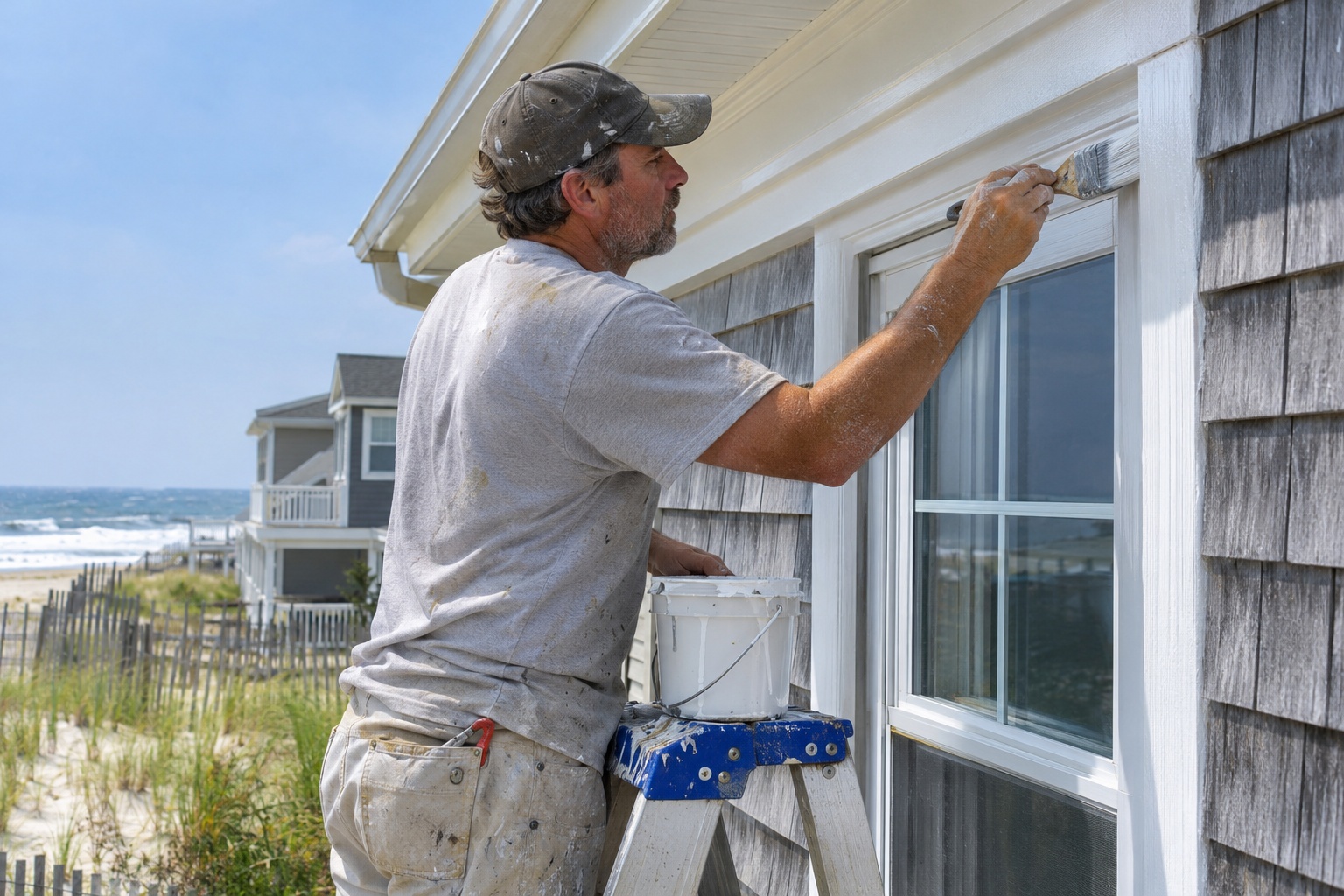
The question homeowners ask most is simple: what type of paint is best for the exterior of a house near the water? For most shore homes, 100% acrylic latex is the strongest starting point.
Benjamin Moore states that acrylic/latex is generally the best choice for exterior projects because it resists sunlight and is compatible with most substrates. Those two traits matter at the shore, where sun, glare off the water and a mix of siding materials are all part of daily life.
Starting point is the key phrase. The right answer depends on what is on the house now, what the surface is made of, and how exposed the property is. A bayfront home with a chalky old coat needs a different plan than a newer house a few blocks inland.
That is why we evaluate the house before recommending a system. We look at:
- The condition and type of the existing coating
- The substrate (wood, vinyl, fiber cement, stucco, brick or composite)
- Signs of peeling, chalking, mildew or corrosion
- How exposed the house is to wind, spray and sun
A recommendation made without those details is a guess. We would rather inspect first and give you a straight answer.
Why 100% Acrylic Is the Starting Point
Acrylic resists sunlight, which helps slow fading and chalking on south and west walls. It also works across most substrates, so one family of paint can cover the whole house.
Shore homes rarely have a single surface. You might have wood trim, vinyl or fiber cement siding, a stucco or brick foundation wall, and composite porch parts on the same house.
Acrylic coatings are also known for flexibility, which helps them move with surfaces as temperatures change. We keep that point general, because how a coating performs still depends on prep and application.
Acrylic vs. Oil-Based Paint in Coastal Air
Is acrylic paint better than oil-based paint in salty coastal air? For topcoats on most exteriors, acrylic is the usual answer, since it resists sunlight and bonds to most substrates.
Oil-based products still have a role in certain prep and priming situations, such as some bare or stained surfaces and some old, hard coatings. Those decisions come from the surface and the technical data sheet, not from a blanket rule.
We avoid sweeping claims either way. The honest approach is to match the product to the substrate and the existing coating, then follow the manufacturer’s directions.
Comparing Benjamin Moore Exterior Lines for Coastal Homes
Homeowners researching this topic usually run into named product lines and spec sheets, so here is an honest look at real options. Each of these is a quality coating, and the right one depends on the house.
This comparison is meant to help you understand what you are looking at, not to send you to the store with a roller. Product choice is one decision inside a larger job that includes washing, repairs, priming and careful application.
| Product line | Formulation | Listed substrates | Notable details |
|---|---|---|---|
| Element Guard | 100% acrylic | Wood, vinyl, brick, stone, stucco, composites, fiber cement | High-moisture formula, mildew-resistant coating, rain-resistant after 60 minutes |
| Regal Select Exterior | Acrylic with alkyd-fortified technology | Vinyl, stone, composite wood, Masonite, brick, composites, wood, stucco | Aimed at easier application and long-term durability |
| Regal Select Exterior High Build | High-build acrylic | Wood, vinyl/PVC, masonry, fiber cement board | Described as resisting harsh weather, including wind-driven rain |
Element Guard: Built for High-Moisture Conditions
Element Guard is a 100% acrylic exterior coating formulated for high-moisture conditions, including wind-driven rain and humidity. That description fits the shore well, which is why it comes up often for coastal homes.
It is described as rain-resistant after 60 minutes and applicable in temperatures as low as 35°F, subject to the product label and site conditions. It also contains a mildew-resistant coating.
It is recommended for wood, vinyl, brick, stone, stucco, composite materials and fiber cement. One caveat matters: rain-resistant after 60 minutes is not the same as fully cured. Recoat and application instructions still apply, and we plan around the forecast.
Regal Select Exterior: Alkyd-Fortified Acrylic
Regal Select Exterior is an acrylic paint with alkyd-fortified technology, intended to improve application and long-term durability. For a painter, application matters, because a coating that lays down smoothly is easier to apply evenly.
It is listed for vinyl, stone, composite wood, Masonite, brick, composite materials, wood and stucco. That range makes it a flexible option on homes with several surface types.
It is a strong all-around line for many exteriors, including homes that see moderate coastal exposure.
Regal Select Exterior High Build: Weather Resistance on Tougher Surfaces
The high-build version is described as resisting harsh weather, including wind-driven rain, and as suitable for wood, vinyl/PVC, masonry and fiber cement board. In plain terms, high build means a thicker film per coat.
A thicker film can help on rougher or more weathered surfaces, where extra thickness helps cover texture. It is not automatically the right choice for every wall.
We evaluate whether it fits the house, because a heavier coat on the wrong surface can create its own problems.
Why No Paint Is “Salt-Air Proof”
The product pages describe moisture, weather and substrate performance. They do not promise protection from marine salt, and we would not either.
No single product is best for every shore house. The existing coating, any peeling, chalking, mildew or corrosion, and the exposure all shape the system we recommend.
Primer, Prep and the Steps That Decide How Long Paint Lasts
Prep and primer choices often matter as much as the topcoat. A premium paint over poor prep will disappoint, and a well-prepared surface gives even a good paint its best shot.
Most of the work on a shore exterior happens before the first coat of finish goes on. That is the part homeowners rarely see, and it is where a professional crew earns its keep.
Prep at the shore usually involves several linked jobs:
- Washing away salt, dirt and chalk
- Scraping and sanding failing paint
- Repairing and caulking gaps and joints
- Priming bare or repaired areas
Do You Need a Special Primer for a Coastal Home?
It depends. Primer requirements vary by substrate and by the finish-coat technical data sheet, which is the guidance Benjamin Moore points painters to.
An acrylic topcoat does not eliminate the need for primer. Bare wood, rusted metal, chalky or glossy old coatings and repaired areas are typical situations where priming is called for.
Some surfaces need spot priming only, while others need full priming. We read the data sheet for the exact system on your house and prime where the surface calls for it.
Washing Off Salt, Spot Priming Rust and Treating Mildew
Our prep sequence at a shore home runs in order: wash off salt, scrape and sand failing paint, spot prime rust on railings and metal, address mildew, caulk and repair, then prime and coat.
Each step protects the next one. Mildew painted over without treatment tends to return, and rust primed over without cleaning tends to bleed through.
This is crew work, done in the right order with the right materials, not a weekend shortcut.
Painting at the Shore in Atlantic County and Beyond
Shore painting is local work. The wind off Absecon Bay is not the same as a block in Egg Harbor Township, and the older houses in Pleasantville have different needs than newer ones in Galloway.
Builder paint is also coming due inland. Subdivisions in Egg Harbor Township from the 1980s to 2000s are reaching repaint age street by street, with chalking and fading on trim, doors and garage doors.
Near the water, conditions get harder, and the next three sections cover how that plays out locally.
Absecon Island and the Bay: Somers Point, Ventnor and Margate
On Absecon Island and along the bay, including Somers Point’s Bay Avenue and Broadway, Ventnor and Margate, salt air is part of daily life. The routine here is to wash salt off before painting, spot prime rust on railings, and use coastal-grade exterior coatings.
Railings and metal fixtures get extra attention, since rust stains travel down onto siding.
Downbeach homes also face strong sun and wind, so we choose coatings and colors with that exposure in mind.
Empty Winter Homes, Flood-Prone Garages and Damp Lagoon Walls
Many shore houses sit empty through winter. In Margate, 62.8 percent of units were vacant in 2020, which tells you how many second homes there are. Peeling can start unnoticed, so we schedule around the season and catch problems early.
Flooding adds another layer. Ship Bottom is entirely in the 100 year floodplain, and ground-level garages and storage on LBI, in the Beach Haven West lagoons and along Lakes Bay in Pleasantville need cleaning, priming and repainting after water.
Lagoon air keeps rear walls damp, which makes mildew treatment and good prep even more important.
Older Wood, Lead Paint and Cedar Shingles
Older homes bring their own rules. Pleasantville houses from the 1910s and 1920s, Ventnor (about 30 percent built before 1939), Absecon’s Shore Road homes from the 1700s and 1800s and Linwood’s Shore Road historic district all call for hand scraping and careful prep.
Older paint can contain lead, so these jobs need extra care rather than speed.
Cedar shingle Cape Cods in Stone Harbor tend to curl and peel at the bottom edges, so the choice between stain and paint is worth a conversation before work begins.
How Often Should a Beach House Exterior Be Repainted?
There is no fixed number we can honestly promise. How long a coating lasts depends on the condition of the surface, the prep, the exposure, the color, the application and ongoing maintenance.
A shaded inland wall and a sunny bayfront wall on the same house can age at very different rates. That is why we look at signs instead of counting seasons.
Watch for these signals that a repaint is approaching:
- Chalk that rubs off on your hand
- Fading, especially on south and west walls
- Peeling or bubbling at trim, edges and joints
- Mildew that returns soon after cleaning
- Rust staining below railings and fasteners
Catching these early usually means simpler prep and a better result. Waiting until paint fails often means more scraping and repair.
Does Opened Exterior Paint Keep, and Which Colors Fade Fastest?
Opened exterior paint can keep for a while if the lid is sealed tightly and the can is stored away from extreme heat and cold. Manufacturer care guides give the specifics for each product, and we follow them.
Saved leftover paint is handy for small touch-ups, though a shore house repaint calls for fresh product matched to the system.
Color matters too. Deep, saturated colors tend to show fading sooner than lighter, more muted ones, especially on sun-baked walls. Wildwood’s doo-wop motels, for example, rely on fade-resistant saturated color to stay bright.
If you love a bold shade, we will talk through how it will wear on your exposure.
Final Thoughts
The right coating matters, and 100% acrylic is a strong starting point for most shore exteriors. Lines like Element Guard, Regal Select Exterior and the high-build option each have their place, depending on the house.
But the results people notice years later come from the steps around the paint: washing off salt, treating mildew, spot priming rust, repairing joints and applying coats with care.
Our crew handles all of that on shore homes, so the paint has the best chance to do its job. A professional job done right is what turns a good product into a good result.
Ready to see what fresh paint does for your home? Call LVS Custom Paints at (609) 778-7451 or request a free estimate.
FAQ
What is the best exterior paint for a house near the Jersey Shore?
A 100% acrylic exterior coating is generally the best starting point, since it resists sunlight and works on most substrates. The specific product depends on the existing coating, the surface and your exposure. No paint is salt-proof, so prep matters as much as the can.
Do I need a special primer before painting my coastal home?
It depends on the surface. Primer requirements vary by substrate and by the finish-coat technical data sheet. Bare wood, rusted metal, chalky or glossy old coatings and repairs usually need priming, and an acrylic topcoat does not remove that need.
How often should a beach house exterior be repainted?
There is no single interval we can promise. It depends on prep, exposure, color, application and maintenance. Chalking, fading, peeling and returning mildew are the signs that tell you it is time.